In Texas truck accident cases, FMCSA regulations define both the governing standards and the ultimate outcome. The Federal Motor Carrier Safety Administration writes the safety standards that every interstate trucking company must follow, and Texas civil courts treat clear violations of those rules as strong evidence of negligence.
A Texas truck accident lawyer who builds these cases starts with the same question every time: which federal regulation was broken, and how does that violation connect to the crash?
The stakes for an injured Texan who suffers catastrophic harm like a traumatic brain injury (TBI) or spinal cord damage are enormous. A regulation violation does more than embarrass a carrier in court. It creates the legal basis for direct claims against the trucking company, expands the pool of potential defendants beyond the driver, and in many cases supports exemplary damages when the violation rose to gross negligence (negligence per se). This is why sending a spoliation letter early in the case is critical for protecting evidence.
Texas highways like I-10, I-35, and I-20 carry more commercial truck traffic than any other state in the country. This volume leads to more catastrophic collisions—including underride and jackknife crashes—and more cases in which the FMCSA rulebook shapes the legal outcome.
Call us at (210) 941-1306 for a free consultation or contact us below. No cost to you unless we win.
What Should I Know?
- FMCSA rules apply to most commercial trucks in Texas.
- Regulation violations support direct negligence claims, not just fault.
- Hours-of-service rules limit drivers to 11 driving hours per day.
- Maintenance, brake, and inspection records are required by federal law.
- Cargo securement violations can pull in third-party loaders as defendants.
- Two-year filing window applies under Texas law.
How does a broken FMCSA regulation help a truck accident case?
When a driver exceeded hours-of-service limits, when a carrier skipped required maintenance, or when cargo was improperly secured, the FMCSA regulation that was broken becomes the central pillar of a Texas truck accident case.
A Texas truck accident lawyer uses these violations to prove fault, expand liability, and increase the value of the recovery.
What FMCSA Is and Why It Matters in Texas Truck Cases
The Federal Motor Carrier Safety Administration is the federal agency that regulates the trucking and commercial bus industries. FMCSA rules are codified in Title 49 of the Code of Federal Regulations, Parts 350 through 399, and they cover virtually every aspect of how commercial trucks operate.
Which Trucks Are Covered
FMCSA rules apply to commercial motor vehicles meeting certain weight, passenger, or hazardous materials thresholds. The most common trigger is a vehicle weighing over 10,001 pounds engaged in interstate commerce. This sweep covers nearly every 18-wheeler, tanker truck, dump truck, and commercial delivery vehicle that uses Texas highways.
Why Federal Standards Apply in State Courts
Although Texas plaintiffs file truck injury lawsuits in state court under state negligence law, FMCSA violations carry significant evidentiary weight.
Texas courts have long treated federal safety regulation violations as evidence of negligence per se, meaning a proven violation of a regulation designed to prevent the type of harm that occurred can establish a key element of the negligence claim.
This federal-state interaction is one of the main reasons trucking cases require attorneys familiar with both layers of law.
Hours of Service Rules and Liability
49 CFR Part 395 governs how long commercial drivers can be on duty and behind the wheel. Hours of Service violations are among the most common foundations of liability in catastrophic Texas truck cases because driver fatigue is a leading cause of crashes.
The Core HOS Limits
For property-carrying drivers, the rules establish several specific time limits:
- 11-hour driving limit: A driver may drive a maximum of 11 hours after 10 consecutive hours off duty.
- 14-hour driving window: A driver cannot drive beyond the 14th consecutive hour after coming on duty.
- 30-minute break: A driver must take a 30-minute break after 8 cumulative hours of driving.
- 60/70-hour limit: A driver cannot drive after 60 hours on duty in 7 consecutive days, or 70 hours in 8 consecutive days.
- 34-hour restart: A driver may reset the weekly limit by taking 34 or more consecutive hours off duty.
Violations of any of these limits create direct evidence of fatigue-related negligence.
How HOS Violations Are Proven
Electronic logging devices, required on most commercial trucks under 49 CFR Part 395 Subpart B, automatically track driving time and on-duty status. ELD data, paired with fuel receipts, weigh station records, and toll transponder logs, can expose drivers who falsified logs or carriers who pressured drivers to violate HOS limits.
Driver Qualification Rules and Liability
49 CFR Part 391 establishes minimum qualifications for commercial drivers and recordkeeping requirements for the carriers that hire them.
What Carriers Must Verify Before Hiring
Carriers must confirm that every driver:
- Holds a valid commercial driver's license: With proper endorsements for the type of vehicle and cargo.
- Passes a Department of Transportation medical exam: Recertified at required intervals.
- Has a clean enough driving record: Reviewed annually under federal rules.
- Passes pre-employment drug and alcohol testing: Under 49 CFR Part 382.
- Was investigated for prior employer history: Through previous safety performance records.
When a carrier puts an unqualified driver behind the wheel and that driver causes a crash, the carrier faces a direct negligent hiring claim independent of any vicarious liability for the driver's conduct.
How Driver Qualification Files Build the Case
Driver qualification files maintained under Part 391 must include the application, license verifications, medical certificates, road test results, annual MVR reviews, and prior employer inquiries. Discovery of these files during litigation often reveals the gaps that support negligent hiring and retention claims.
Vehicle Maintenance and Inspection Rules
49 CFR Part 396 requires carriers to systematically inspect, repair, and maintain every commercial motor vehicle under their control.
Required Inspections
Federal rules require:
- Annual periodic inspections: With written records preserved.
- Daily pre-trip inspections: Documented in driver vehicle inspection reports (DVIRs).
- Roadside inspection compliance: When state or federal officers stop a truck for inspection.
- Repair documentation: Every defect noted on a DVIR must be repaired before the truck returns to service.
What Failed Maintenance Looks Like in Court
Maintenance records often expose carriers that deferred brake adjustments, ignored tire wear, skipped coupling inspections, or kept trucks in service after known mechanical defects.
A pattern of missed maintenance combined with a mechanically related crash supports a direct negligence claim against the carrier and, in serious cases, a gross negligence finding that opens exemplary damages.
Cargo Securement Rules and Third-Party Liability
49 CFR Part 393 Subpart I sets specific requirements for how cargo must be loaded, distributed, and secured on commercial vehicles.
What the Rules Require
Cargo securement rules establish:
- Tie-down strength minimums: Based on cargo weight and characteristics.
- Working load limits: For chains, straps, and binders.
- Distribution requirements: Preventing weight from shifting during normal driving and braking.
- Special rules for specific cargo types: Including logs, flatbed loads, vehicles, intermodal containers, and roll-on/roll-off equipment.
Why Cargo Loaders Become Separate Defendants
When a third-party logistics company, warehouse operator, or shipper loaded the truck, that party can be sued separately for cargo-related crashes. A direct negligence claim against the cargo loader often opens an entirely separate insurance policy beyond the trucking company's coverage, which becomes important in catastrophic injury cases that exceed any single defendant's policy limits.
Brake System Standards and Mechanical Failures
49 CFR Part 393 Subpart C governs commercial truck braking systems, including air brakes, parking brakes, and required performance standards.
Why Brake Violations Anchor So Many Cases
The FMCSA's Large Truck Crash Causation Study identified brake problems in 29 percent of large trucks involved in fatal and injury crashes, the most common vehicle-related factor by a wide margin.
Brake violations can support claims against several parties, including the carrier, maintenance contractors, or parts manufacturers.
- The carrier: For deferred maintenance under Part 396.
- The maintenance contractor: For substandard repairs.
- The parts manufacturer: For defective brake components.
- The driver: For continuing to operate a truck with known brake defects.
Each of those defendants often carries its own insurance policy.
Drug and Alcohol Testing Rules
49 CFR Part 382 requires commercial drivers to undergo:
- Pre-employment testing.
- Random testing throughout the year.
- Reasonable suspicion testing when warranted.
- Post-crash testing for crashes meeting certain severity thresholds.
- Return-to-duty testing after a violation.
A post-crash drug or alcohol test result can convert an ordinary negligence case into a gross negligence case, opening exemplary damages under Texas Civil Practice and Remedies Code Chapter 41. The federal commercial driver alcohol limit is 0.04, half the limit for passenger vehicles, which means a finding well below typical DWI thresholds can still produce a violation.
How Multiple Regulations Stack in a Single Case
The most catastrophic Texas truck cases rarely involve a single regulatory violation. They involve patterns. A typical fatal truck crash investigation might reveal:
- An HOS violation under Part 395
- A driver qualification gap under Part 391
- A skipped maintenance issue under Part 396
- A brake adjustment problem under Part 393
- A post-crash drug test result under Part 382
Each violation reinforces the others, building a picture of carrier conduct that supports both compensatory and exemplary damages.
Texas Statute of Limitations and Federal Regulation Cases
Even when federal regulations form the foundation of a Texas truck case, the lawsuit itself is filed under Texas state negligence law and is subject to Texas filing deadlines.
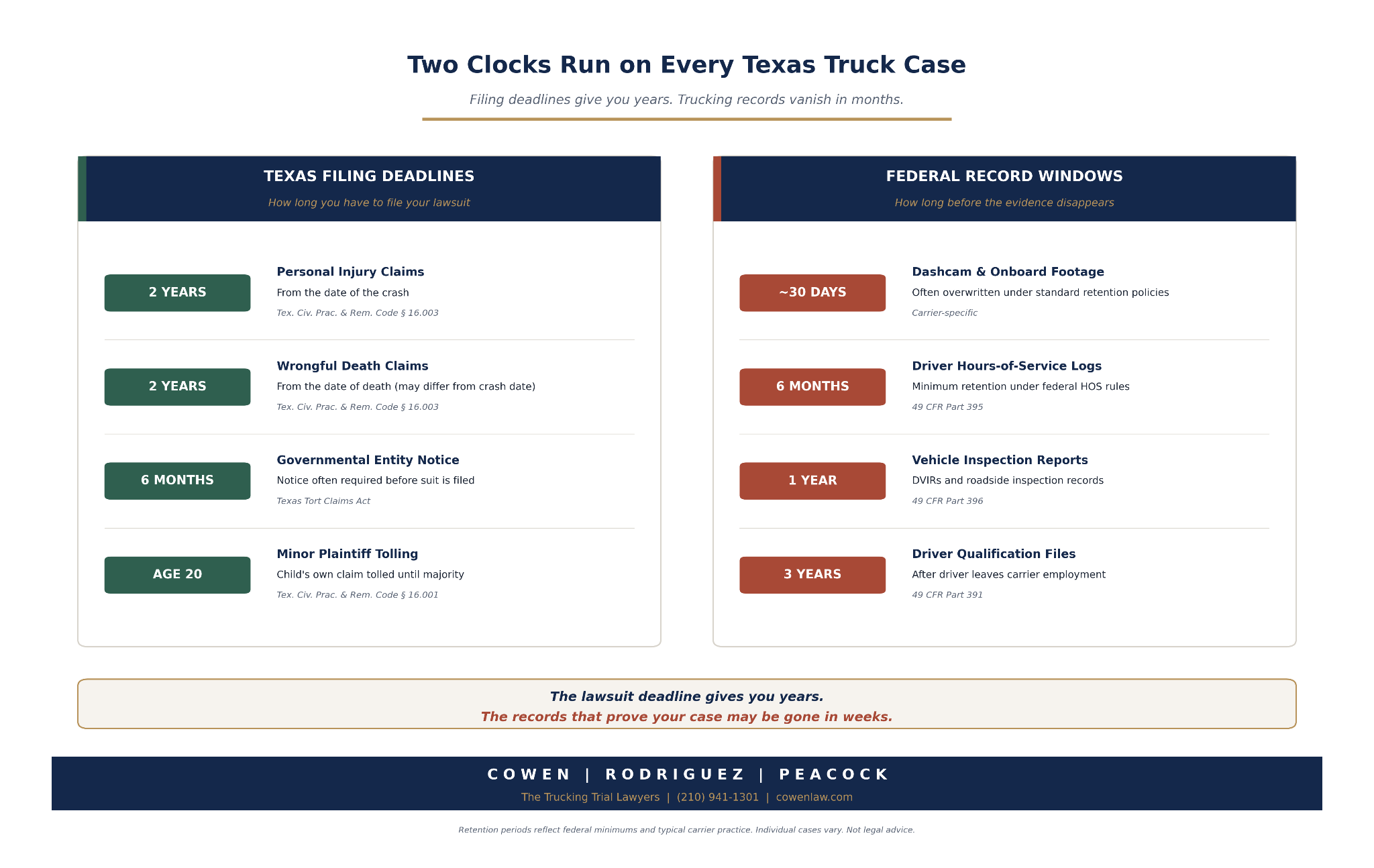
- Personal injury claims: Two years from the date of the crash under Texas Civil Practice and Remedies Code Section 16.003.
- Wrongful death claims: Two years from the date of death, which may differ from the crash date if the victim survived for a period before passing.
- Claims against governmental entities: Notice requirements often run within months of the crash and are separate from the lawsuit-filing deadline.
- Minor plaintiffs: Tolling under Section 16.001 may extend the deadline for the child's own claim, though parental claims for medical bills run on the standard two-year clock.
Federal preservation deadlines on records can run far shorter than these civil deadlines, which is why early action protects the case even when the lawsuit itself does not have to be filed for months.
FAQs About FMCSA Regulations and Texas Truck Cases
Do FMCSA rules apply to in-state trucking in Texas?
Federal FMCSA rules apply to interstate commercial trucking, but Texas has adopted most of the same standards for intrastate commercial vehicles through the Texas Department of Public Safety. The practical result is that the federal safety standards apply to nearly every commercial truck operating on Texas roads, regardless of whether the trip crosses state lines.
How does a regulation violation actually prove negligence?
Texas courts treat violations of safety regulations designed to protect against the kind of harm that occurred as evidence of negligence per se. A proven violation establishes the breach of duty element, which means the case shifts to proving that the violation caused the crash and the resulting damages.
What if the trucking company says the violation was unintentional?
Whether the violation was intentional matters less than whether it occurred and contributed to the crash. Many regulation violations carry strict liability. Even genuinely accidental violations can support compensatory damages, although intentional violations and patterns of disregard become important when exemplary damages are pursued.
Can I obtain a truck driver's logs and maintenance records?
Discovery in a Texas truck case typically requires production of these records, but only if the case is filed before the records are destroyed under standard retention schedules. Driver logs may be retained for six months under HOS rules, and dashcam footage often disappears within 30 days. Sending preservation letters early in the case is critical.
Moving Forward
A Texas truck accident case built on FMCSA regulations is different than a standard car crash claim. The regulations create options for more defendants, more theories, and more insurance policies, and they often shift the value of the case by an order of magnitude. The key challenge, however, is that the federal record disappears quickly without aggressive preservation.
What would it mean for your case to have a Texas truck accident lawyer audit every applicable regulation, preserve every record before it vanishes, and turn the federal rulebook into the foundation of your recovery?
The firm's founders, Michael Cowen and Malorie Peacock, are Board Certified in Personal Injury Trial Law by the Texas Board of Legal Specialization, reinforcing our expertise in Wrongful Death Claims and core Texas Truck Accident Lawyer matters.
Contact Cowen | Rodriguez | Peacock at (210) 941-1301 to talk through the details of your situation.
Call us at (210) 941-1306 for a free consultation or contact us below. No cost to you unless we win.