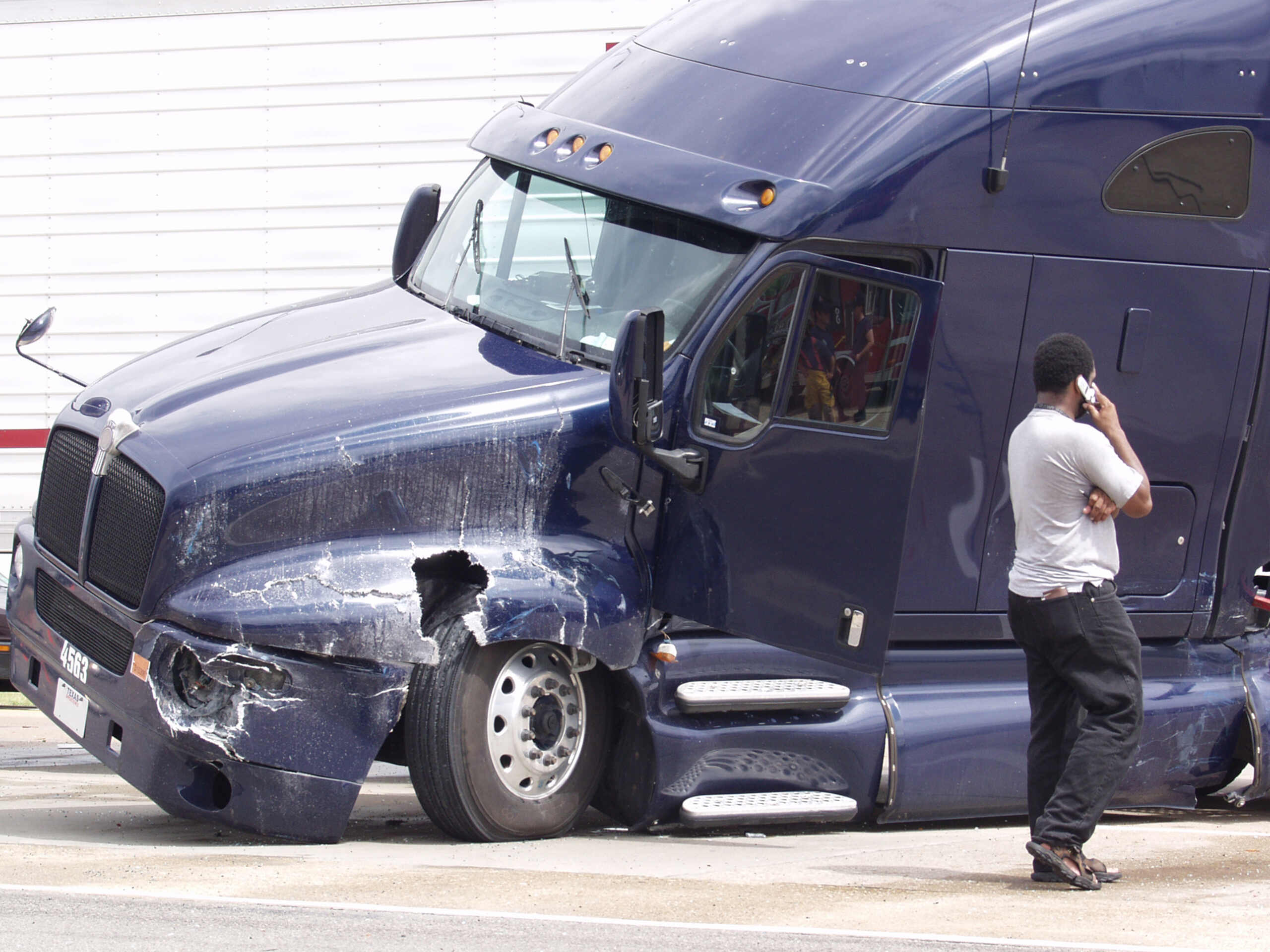
A jackknife truck accident on a Texas highway is one of the most violent crash scenarios on the road. The trailer of an 18-wheeler swings outward, the rig folds in on itself like a closing pocketknife, and the sweep across multiple lanes hits anything in its path.
The federal government tracks these crashes closely. The Federal Motor Carrier Safety Administration's Large Truck Crash Causation Study found brake problems present in 29% of large trucks involved in fatal and injury crashes, the most common vehicle-related factor. Driver fatigue was a critical reason in roughly 13% of those crashes.
Texas, with the most commercial truck miles driven of any state and freight corridors running along I-10, I-35, I-20, and I-45, sees more of these catastrophic crashes than anywhere else in the country.
Call us at (210) 941-1306 for a free consultation or contact us below. No cost to you unless we win.
Key Takeaways for Jackknife Truck Accident Cases
- A jackknife accident is caused by the trailer folding in on the cab due to factors like hard braking, speeding, or mechanical failure.
- Liability extends far beyond the truck driver to include the trucking company (for negligent maintenance or hiring), cargo loaders, and parts manufacturers.
- Critical evidence (like ELD data and dashcam footage) is often overwritten within weeks, making immediate preservation essential for any claim.
- Texas sees the most of these crashes in the nation due to its vast freight corridors (I-10, I-35, I-20, I-45) and high volume of commercial traffic.
What is a Jackknife Accident?
A jackknife truck accident happens when a tractor-trailer's trailer swings out from the cab and folds at a sharp angle, often blocking multiple lanes of Texas highway. Common causes include hard braking, brake failure, speeding, driver fatigue, and improperly loaded cargo.
Why Does Jackknife Accident Investigation Matter?
A thorough investigation is critical because liability often extends beyond the driver, critical evidence disappears quickly, and Texas law enforces a two-year statute of limitations for these claims.
- Brake problems are the leading mechanical cause.
- Cargo loading is a separate liability source.
- Liability often extends beyond the driver.
- Critical evidence disappears fast.
- Texas plaintiffs have two years to file.
Learn how jackknife and rollover truck crashes happen in Texas and what steps victims can take to protect their rights after a serious trucking accident.
What is the Mechanism of a Jackknife Truck Crash?
A jackknife crash occurs when a tractor-trailer's two connected pieces—the cab and the trailer—lose alignment, causing the trailer to pivot violently around the fifth wheel coupling.
Both end the same way: a folded rig, a destabilized trailer swinging across lanes, and high-speed contact with anything nearby.
Why Do Texas Highways See So Many Jackknife Crashes?
Texas freight corridors carry more truck traffic than any other state. Long rural stretches at high speed, urban congestion in San Antonio, Houston, Dallas, and Austin, and frequent weather changes between regions all create conditions where jackknifes become more likely. FMCSA crash data consistently shows Texas leading the nation in commercial truck crashes.
What Are the Common Causes of Jackknife Truck Accidents in Texas?
Most jackknife crashes trace back to one or more identifiable causes, and proving the cause is usually the first step in proving liability.
How Does Sudden or Improper Braking Cause a Jackknife?
Hard braking is the most frequent trigger because the trailer's momentum continues even as the cab decelerates. When a driver slams the brakes in response to traffic, an animal, or distraction, the trailer pivots sideways if the brakes lock or the anti-lock system fails. Braking on a curve magnifies the problem because weight is already shifting laterally before the brakes engage.
How Do Brake System Failures Lead to Jackknife Accidents?
Mechanical brake problems remain the most common vehicle-related cause of large truck crashes. 49 CFR Part 393 Subpart C sets specific standards for commercial truck braking systems, including air brake pressure, balance across axles, and minimum stopping distances.
Common brake-related causes include:
- Out-of-adjustment brakes: Brakes not adjusted to specification can apply unevenly, causing one axle to lock while others continue moving.
- Worn brake pads or shoes: Excessive wear reduces braking force and creates imbalance between axles.
- Air system leaks: Slow leaks can leave the trailer's brakes underpowered or non-responsive.
- ABS failure: Anti-lock systems are required on most modern commercial trucks. When ABS fails, the chance of a wheel-locking jackknife rises sharply.
- Skipped maintenance: Carriers that defer brake inspections to keep trucks on the road create the conditions for catastrophic failure.
Brake violations show up routinely in Texas DOT inspection records, and a history of brake-related citations supports a claim of negligent maintenance.
Why Is Excessive Speed a Major Risk Factor?
Speed magnifies risks by reducing stopping distance and increasing the rig's center of gravity. A truck traveling too fast for the road, weather, or curvature is less stable. When a sudden braking event happens at high speed, the trailer's momentum overwhelms the friction available at the tires, and the rig folds.
How Does Driver Fatigue Contribute to Jackknifing?
Fatigue impairs reaction time and judgment, both of which feed directly into the panic-braking and overcorrection patterns that cause jackknifes. Federal Hours of Service rules under 49 CFR Part 395 limit how long commercial drivers can remain behind the wheel, and electronic logging devices track compliance.
When ELD records show a driver exceeded HOS limits before a crash, that violation becomes central evidence.
How Does Improperly Loaded Cargo Cause a Trailer to Pivot?
Shifting cargo changes the trailer's center of gravity at critical moments, potentially triggering a pivot. Federal cargo securement rules under 49 CFR Part 393 Subpart I require specific tie-down strength and weight distribution. A cargo loader who cuts corners on these rules can trigger a jackknife independent of any driver error.
How Do Adverse Weather and Road Conditions Affect Traction?
Wet pavement, ice, oil spills, debris, and construction zones all reduce tire traction. Texas weather changes quickly, and a driver who fails to slow down for rain, fog, or sudden cold snaps creates the same loss-of-traction conditions that produce mechanical jackknifes.
These causes rarely appear in isolation. Most jackknife investigations identify two or three factors stacking on top of each other, which is why the case requires careful reconstruction.
Who Can Be Held Liable for a Texas Jackknife Crash?
Liability in a jackknife crash often reaches well beyond the driver behind the wheel. Texas law allows injured parties to pursue every entity whose negligence contributed to the loss of control.
Truck Drivers
The driver is the first place liability investigations begin. A driver who braked improperly, exceeded the speed limit, drove while fatigued, or operated outside HOS rules may be personally liable.
Driver liability rarely ends the inquiry, however, because most commercial drivers are employees or contractors of larger entities with deeper insurance coverage.
The Trucking Company
Motor carriers can be liable under several theories. Vicarious liability under respondeat superior makes the company responsible for the negligent acts of its drivers within the scope of employment. Direct claims include:
- Negligent hiring: Putting an unqualified or unsafe driver behind the wheel.
- Negligent training: Failing to train drivers on emergency braking, jackknife recovery, or load handling.
- Negligent retention: Keeping a driver on staff after warning signs of unsafe operation.
- Negligent supervision: Pressuring drivers to violate HOS rules or skip mandatory rest.
- Negligent maintenance: Failing to inspect and repair brakes, tires, and coupling systems as required.
Carrier records, including driver qualification files, maintenance logs, and dispatch records, are central to building these claims.
Cargo Loading Companies
When a third party loads or secures cargo, that party can be sued separately for jackknifes caused by shifted or improperly distributed loads. Logistics providers, warehouse operators, and shippers all carry potential liability for cargo securement violations. A direct claim against a cargo loader often opens an additional insurance policy beyond the trucking company's coverage.
Maintenance Contractors
Many trucking companies outsource fleet maintenance to independent service centers. When a third-party shop performs substandard repairs, installs incorrect parts, or certifies a truck as roadworthy when it has known defects, that shop can be held liable as a separate defendant.
Manufacturers
If a brake system, tire, coupling, or other component failed because of a manufacturing or design defect, the manufacturer of the defective part can be sued under Texas product liability law. These claims are technical and require qualified engineering analysis, but they often provide significant additional recovery in catastrophic jackknife cases.
Freight Brokers and Shippers
In some cases, freight brokers or shippers who selected an unqualified or unsafe carrier may face negligence claims of their own. These theories vary by case facts, but they can reach significant insurance coverage when applicable.
What Evidence Can Be Used to Prove Fault or Negligence?
Several sources of evidence can be used to prove liability, including:
- Electronic logging device (ELD) data: Records the driver's hours of service, speed, braking events, and engine activity. Can be overwritten within weeks under standard retention policies.
- Dashcam and onboard camera footage: Many modern trucks carry forward and driver-facing cameras. Footage is often deleted within 30 days unless legally preserved.
- Driver qualification files: Required under 49 CFR Part 391, including medical certificate, prior employer history, and motor vehicle records.
- Maintenance and inspection records: Required under 49 CFR Part 396, documenting brake adjustments, tire replacements, and component repairs.
- Post-crash drug and alcohol test results: Required under 49 CFR Part 382 for crashes meeting certain severity thresholds.
- Cargo manifests and bills of lading: Show what was loaded, by whom, and how it was secured.
- Vehicle inspection reports: Texas DPS commercial vehicle inspections create a paper trail of past safety violations.
Securing these records requires preservation letters issued within hours of their retention on the case. Trucking companies frequently rotate or recycle records on schedules far shorter than the two-year statute of limitations.
What Injuries Are Common in Texas Jackknife Crashes?
Catastrophic injuries are common because of the high speeds and massive impact forces involved in jackknife crashes.
Common diagnoses include traumatic brain injuries, spinal cord damage, and internal organ lacerations. Recovery often requires years of medical care.
- Traumatic brain injury: From impact, rotation, or contrecoup forces during the collision.
- Spinal cord damage: Including incomplete and complete injuries that can result in paralysis.
- Multiple fractures: Particularly in the legs, pelvis, and ribs from the side-impact geometry of jackknife collisions.
- Internal organ damage: Lacerations to the spleen, liver, kidneys, and lungs from blunt force.
- Severe burns: When fuel ignition or cargo fire follows the collision.
- Crush injuries: When the trailer pins or rolls onto a passenger vehicle.
Recovery from these injuries often requires years of medical care, and the value of a jackknife case is shaped as much by the future medical projection as by past medical bills.
FAQs About Texas Jackknife Truck Accidents
Is a jackknife crash always the truck driver's fault?
Not necessarily. Investigation often reveals that the crash was caused or worsened by mechanical failure, defective equipment, improper cargo loading, or poor road maintenance. Determining fault requires reviewing ELD data, maintenance records, cargo documentation, and accident reconstruction. Texas allows recovery from every party whose negligence contributed to the crash.
How long do trucking companies keep records after a jackknife crash?
Federal regulations require certain records to be kept for set periods, but many trucking companies dispose of optional records as soon as legally permitted. Driver logs may be retained for six months under HOS rules, dashcam footage may be overwritten within 30 days, and inspection records may be kept for one year. Sending preservation letters immediately is the only reliable way to protect this evidence.
What if the trucking company tries to settle quickly after a jackknife crash?
Quick offers are common in catastrophic truck cases because the company knows the case is worth significantly more than the early offer. Signing a release before injuries fully present and before a life care plan is built almost always results in undercompensation. Reviewing any offer with a Texas truck accident lawyer before signing protects the value of the case.
Can I still recover if I was partly to blame for the crash?
Texas follows modified comparative fault under Texas Civil Practice and Remedies Code Chapter 33. You can recover damages as long as your share of responsibility is 50 percent or less, with your final award reduced by your percentage of fault. Pushing back on inflated comparative fault arguments with reconstruction evidence is a standard part of the case.
Moving Forward
A jackknife truck accident is rarely a single-cause event, and the case that follows is rarely a single-defendant case. The driver, the carrier, the loader, the maintenance shop, and the parts manufacturer may all share responsibility for what happened, and the recovery available to the injured person depends on identifying every contributing party before evidence disappears.
What would it mean for your case to have a Texas truck accident lawyer preserve the records, depose the right witnesses, and build the multi-defendant case that catastrophic injuries actually require?
Contact Cowen | Rodriguez | Peacock at (210) 941-1301 to discuss the details of your situation.
Call us at (210) 941-1306 for a free consultation or contact us below. No cost to you unless we win.